I want to tell you something about the car you drove to work this morning.
It is not the same kind of machine your parents drove. It is not even close. The average vehicle on the road today has somewhere around 17 onboard computers managing everything from your engine and transmission to your brakes, your climate control, your infotainment system, and increasingly, your safety systems. By the mid-1990s, manufacturers had already begun embedding layers of electronic complexity into their vehicles that changed this industry forever — and it has only accelerated since then.
I have been fascinated by automotive electronics since before most of the cars on the road today were built. It is my specialty, and honestly, it is one of the things I love most about this work. But it also means I have watched firsthand as the gap between what a truly trained technician can do and what an undertrained one can do has grown wider every single year.
That gap is exactly why ASE certification matters — and why it matters more now than ever before.
What Does ASE Certification Actually Mean?
ASE stands for Automotive Service Excellence. It is the nationally recognized standard for testing and certifying automotive technicians in the United States. To earn ASE certification, a technician must pass rigorous written exams in specific areas — engine repair, electrical systems, brakes, transmissions, heating and air conditioning, and more — and demonstrate real-world work experience.
A Master Technician, which is my designation, has passed exams across all eight of the major ASE automotive areas. It takes years of study, testing, and hands-on experience to earn, and it requires ongoing recertification to maintain.
At Dick’s Automotive, nearly all of our technicians are ASE certified. We invest in their education, we give them the time to train, and we make sure they have the tools and technology to do their jobs at the highest level. That is not an accident — it is a deliberate choice I make as an owner because I believe our customers deserve nothing less.
How Complex Have Modern Vehicles Actually Become?
Let me give you a sense of the scale we are dealing with.
| Vehicles typically have… |
In the 1980s |
Today (mid-2020s) |
| Onboard computers |
1–2 |
17 or more |
| Lines of software code |
Minimal |
100 million+ |
| Diagnostic trouble codes (DTCs) |
A few dozen |
Over 10,000 |
| Electronic control systems |
Basic ignition/fuel |
Engine, transmission, ABS, ADAS, HVAC, infotainment, and more |
| Diagnostic approach |
Visual/mechanical |
Scan tool + live data + system-specific expertise |
When a warning light comes on in your vehicle today, it is not necessarily telling you something simple. That check engine light alone can be triggered by more than 10,000 different diagnostic trouble codes. Some of them are straightforward. Many of them are not. And diagnosing the real root cause — not just reading a code and replacing a part — requires a technician who understands how all of these systems interact with each other.
I have seen vehicles come in where a customer was told by another shop that the problem was one thing, a part was replaced, and the light came back on within a week. That is not a parts problem. That is a diagnostic problem. The wrong diagnosis leads to the wrong repair — and you end up paying twice.
Why Electrical System Expertise Is a Different Kind of Skill
Electrical diagnostics is not like changing a filter or replacing brake pads. It requires a different kind of thinking — methodical, patient, and deeply technical. You have to understand how circuits work, how computers communicate with each other inside a vehicle, and how to use diagnostic equipment to trace a problem to its actual source rather than its most obvious symptom.
This is where I find my background in mathematics genuinely useful. Electrical diagnosis is problem-solving in a very structured, logical way. I struggled in some areas of school, but math came naturally to me — and automotive electronics rewards that kind of thinking. I genuinely enjoy it, which I think matters. Technicians who find this work interesting are better at it than technicians who find it frustrating.
Our team approaches diagnostics the same way. We do not guess. We do not replace parts hoping to get lucky. We invest time in understanding what is actually happening — because that is what gets your car fixed correctly, and that is what earns your trust.
What to Expect When You Bring Your Vehicle in for Diagnostics
When you bring your vehicle to Dick’s Automotive for a diagnostic service, here is what happens:
- We connect your vehicle to our professional-grade diagnostic equipment and retrieve all stored trouble codes across every system.
- We review live data — not just the codes, but the real-time readings from sensors and modules that tell us how your vehicle’s systems are actually performing.
- We trace the problem to its root cause. A code is a starting point, not a conclusion. We do the work to understand what is driving the symptom.
- We explain what we found — in plain language, with a visual walk-through if that is helpful. You will know exactly what the problem is, what it takes to fix it, and what it will cost before we do anything.
- We use quality parts and stand behind our work with a 3-year / 36,000-mile warranty.
Education Is Part of What We Do
I have always believed that an educated customer makes better decisions — for their vehicle and for their budget. When you bring your car to us and we find something, we do not just hand you an estimate and wait for you to decide. We take the time to explain what we found, why it matters, and what happens if it goes unaddressed.
Some customers want every detail. Some just want the bottom line. We adapt to what works for you. But the offer to understand is always there — because I think you deserve to know what is happening with your vehicle. It is your car, your money, and your safety.
Women in particular often tell me they appreciate this approach. They want to understand the value, not just the price. And once they do, they tell everybody. That kind of trust is built one honest conversation at a time.
The Shortage of Qualified Technicians — And Why It Matters to You
Here is something the industry does not talk about enough: there is a serious and growing shortage of qualified automotive technicians in this country. The vehicles are getting more complex every year, but the pipeline of trained technicians has not kept pace.
This is something I have taken personally. I work with local high schools and career programs to introduce students — including young women — to what a career in automotive technology actually looks like. The pay is good, the work is meaningful, and the industry needs them. Parents sometimes steer their kids toward other professions without realizing what a skilled technician can earn and what kind of impact they can have.
What this shortage means for you as a consumer is that the quality of the shop you choose matters more than it ever has. Not every shop has the same level of training, the same diagnostic tools, or the same commitment to doing the job right. ASE certification is one way to know your technician has met a real standard — not just a self-declared one.
Schedule Your Diagnostic Appointment at Dick’s Automotive
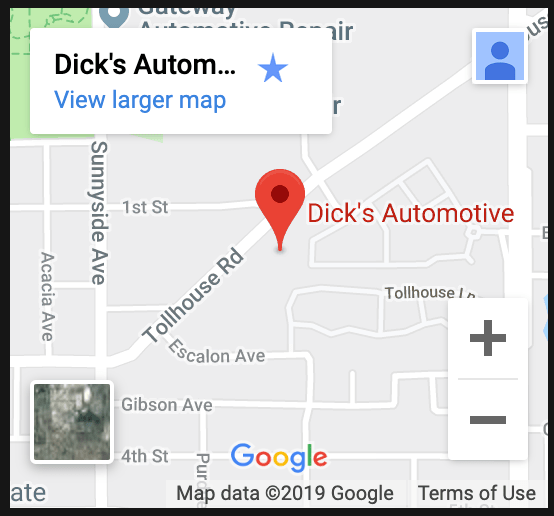
If your check engine light is on, your vehicle is behaving differently than it should, or you simply want a thorough electrical system inspection, we are here to help. Dick’s Automotive is located at 1550 Tollhouse Road in Clovis, CA — serving Clovis, Fresno, and the Madera area. Call us at 559-299-2226 or visit dicksautomotiveinc.com to schedule your appointment. Let our ASE-certified team get it right the first time.
Dick’s Automotive | 1550 Tollhouse Road, Clovis, CA 93611 | 559-299-2226 | dicksautomotiveinc.com